
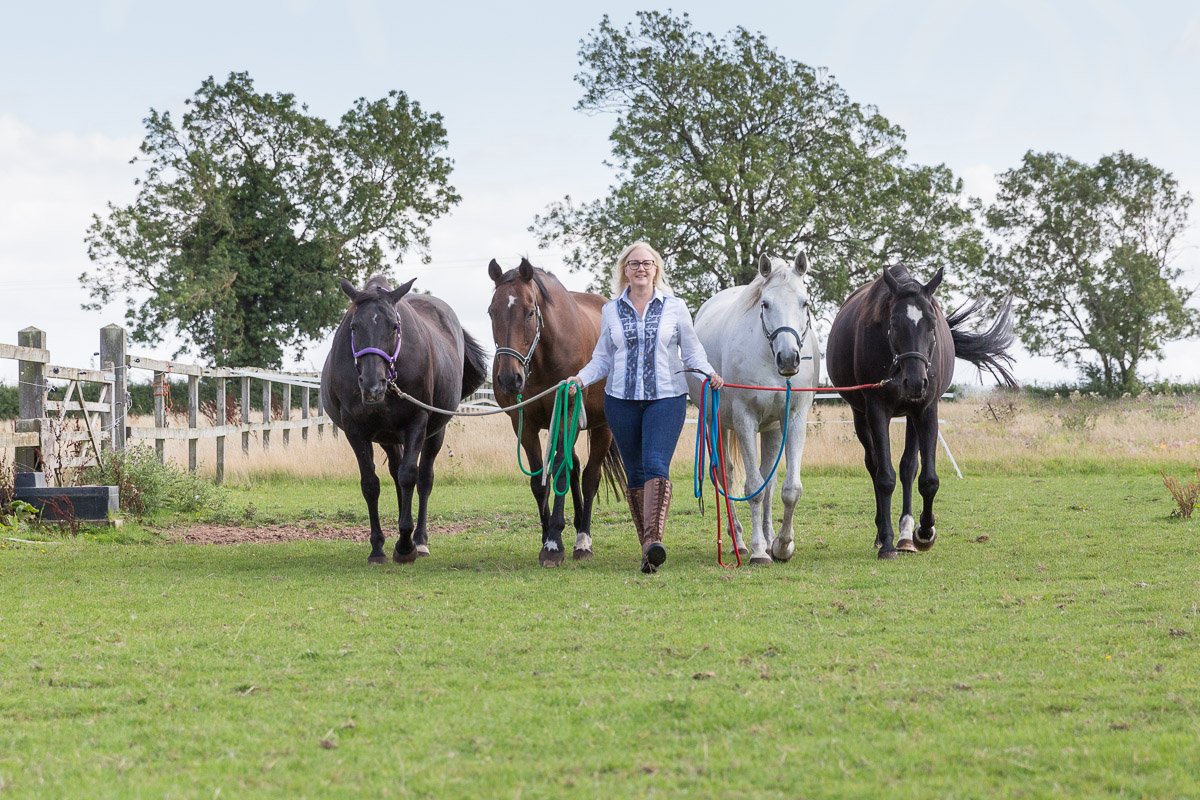


What is Leadership with horses?
How does it work?
Here are some of the common questions I am asked
Leadership with horses, also called equine-facilitated leadership, is experiential leadership and team development in which you work with a herd of horses on the ground to reveal and change your default nonverbal behaviour.
The horses reveal the automatic patterns that drive performance under pressure, giving leaders instant, non-judgemental feedback that you cannot get in a classroom or from a psychometric report.
What is Leadership with horses?
Leadership with horses, sometimes called equine-facilitated leadership, is an approach to leadership and team development that involves working with a herd of horses to explore nonverbal behaviour and communication.
I combine the experiential learning of working with horses with coaching and leadership and team skills, so you can see your default patterns of behaviour and change them.
Why horses?
Horses respond to your nonverbal communication and reveal your default patterns of behaviour out of your comfort zone. They need clarity of direction balanced with a strong relationship built on trust and respect. They come with you when those are in balance, and refuse to engage when they are not, which gives you the clearest feedback you will ever get, without judgement.
Could you work with other animals instead?
There is something particular to horses:
the depth of connection is greater than most other animals
the leadership they ask of you is a direct parallel to the leadership your people need from you
research shows that in their presence you align your head, heart and gut, slow down your breathing and reset your sympathetic nervous system, enabling you to operate from a place of authenticity rather than stress
and their presence, size and power invite you to step into your own, as well as providing a context of uncertainty and stretching out of the comfort zone.
How does it work?
Leadership with horses is done on the ground, with no riding. Sometimes we work with the horses loose in the field, and sometimes participants lead the horses in an arena. We do some work one to one and some as a team, so you get feedback on how you lead as an individual and how you lead together.
My role as your coach is to help you make sense of the experience and map it back to your workplace, so you can make changes that make you more effective as a leader and as a team.
Do you ride the horses?
No. There is no riding, and no experience with horses is required. The work is designed to be accessible whatever your familiarity with horses, and it suits people who are frightened of horses as much as experienced riders. The horses respond to your presence and nonverbal behaviour, not your techniques.
Are the horses safe to work with?
We provide a safety briefing and show you how to handle the horses safely. The horses have been chosen specifically to do this work based on their safety around people they do not know. Every session is guided by Jude Jennison, who has worked with horses in this way for 16 years, and horse handlers guide you throughout and keep the environment safe and supportive.
Are the horses trained to do this work?
No, they are rescue horses who cannot be ridden. They have been chosen for their willingness to connect with strangers. Beyond that, they are encouraged to have opinions. They are never forced to do anything they do not want to do. Often the horses present themselves at the gate because they want to work with somebody.
What if someone is terrified of horses?
This is common, and it is where my own work began. I was afraid of horses, and it was in overcoming that fear that I found this way of working with them to develop leadership and teams. Fear is an emotion we all know. I will help you reframe fear into respect in a matter of minutes, and help you lead confidently outside your comfort zone in other situations at work.
What happens in a session?
You lead a horse through simple ground-based exercises while the session is facilitated and observed. The horse responds to your calm, clarity and presence, or the absence of them. You then practise a different way of leading and watch the response change in real time. Reflection and coaching turn each moment into insight you take back to work.
Sometimes you will lead a horse on a one to one basis, sometimes in pairs or teams. Each exercise is debriefed so you map the learning back to work and life situations and find solutions to your common leadership issues.
Who is it for, and what result does it get?
I work with senior leaders and executive teams in large organisations and fast-growing entrepreneurial businesses, through talent development workshops, team alignment programmes and one to one coaching with horses. For the full picture of who this is for, the frameworks behind it and the results clients achieve, see The Approach. If you are not sure whether it fits, book a call and we will explore it.
How is this different from classroom courses or psychometric testing?
Classroom courses and psychometric tests give you knowledge and language about how you lead. They are based on standard approaches and rarely change what you do under pressure. Horses respond to behaviours, based on emotions, thoughts, body language and intentions, including your subconscious processes. So you get an immediate pattern interrupt, discover your unconscious default patterns of behaviour and practise a new way of leading throughout the day. That is why the learning results in changes in behaviour back in the workplace.


